
Author: rory-admin

  • If you’ve never heard of the Log4J vulnerability, you’re probably at risk

    If you’ve never heard of the Log4J vulnerability, you’re probably at risk

    News is moving fast on the Log4J vulnerability, also known as “Log4shell”. It was first discovered in the video game Minecraft, developers realized hackers could exploit the vulnerability to gain access to the targeted computer and take it over. They quickly released a patch but also made a disclosure that brought the exploit to the public’s view.

    The Cybersecurity & Infrastructure Security Agency (CISA) has now made a running repository that lists all of the software and devices vulnerable to this exploit. There you will find guidance on patching the effected products.

    So, what is the Log4J vulnerability and what does it do?

    It all stems from the building blocks that are used when a programmer is creating their code. Programmers will take bits of code that commonly available and used to act as a foundation for the program they’re trying to write, and in this case one of those foundational bits of code was Log4J. Log4J is used by Java to create a log of activity for the device it’s running on. It copies everything that happens as the program runs, and it makes sense that the vulnerability was initially discovered in Minecraft (a Java based game).

    This communicative bit of code is found in many different programs, which is why it could be devastating if it was widely exploited. Hackers would be able to send a message to the “Log4J” effected product giving it commands. This would essentially allow them to take over the device and have full access.

    Minecraft Isn’t the only thing based in Java either, Java is an extremely popular programming language and bits of it can be found in almost everything. Created in 1995, Java can be found on everything from your own personal laptop to the supercomputers used to solve complex scientific equations. 9937 companies openly report including Java in their tech stack, including Google, Airbnb, Amazon and more.

    Java is also the preferred language for mobile applications, such as Android. Any business interested in having a mobile facing application (which they absolutely should considering mobile devices command the highest percentage of the worldwide web traffic at 54.8%) will need to utilize Java to accomplish it.

    This is so much to say, Java is in nearly everything which makes an exploit that targets a common component of it a recipe for disaster.

    All is not lost however, now that the exploit has been discovered many businesses are working furiously on patches and notifying their customers. You can check the CISA link found at the beginning of this article to keep track of what’s being done by specific businesses.
    Click to open the full size version.

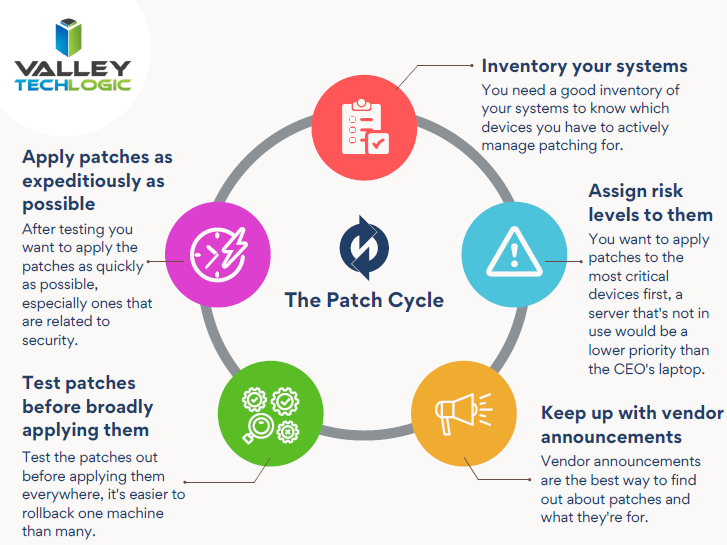
    This ordeal is a good reminder to stay up to date on patches that are offered by the software you utilize, but if you’re running a business, orchestrating patching across many different devices company wide can be much more difficult.

    Valley Techlogic offers preventative maintenance in all of our service plans, as well as disaster recovery services if the unthinkable does occur. Learn more today by scheduling a short consultation with us.

    Looking for more to read? We suggest these other articles from our site.

    This article was powered by Valley TechLogic, IT service provider in Atwater, CA. You can find more information at https://www.valleytechlogic.com/ or on Facebook at https://www.facebook.com/valleytechlogic/ . Follow us on Twitter at https://x.com/valleytechlogic.

  • AWS had an outage this week that took out many top websites and is causing delivery issues for Amazon

    AWS had an outage this week that took out many top websites and is causing delivery issues for Amazon

    Amazon Web Services (AWS) is so prevalent in their cloud services they could be considered an internet backbone. Their cloud computing network is so ubiquitous with online web hosting it would be difficult to find a business that doesn’t utilize their service for some or all of their online hosting requirements.

    So, when an outage occurs on their networks the effects are far reaching and severe. This week’s outage lasted five hours and effected major players – such as Netflix, Southwest Airlines, the Associated Press, Delta and more. The outage mostly occurred on the east coast but even Amazon’s own e-commerce site was affected, which may cause delays in some deliveries as Christmas shopping is in full swing.

    This outage echo’s the Facebook outage that happened on October 4th  in that there is a ripple effect that occurs when these large providers have an outage. This instance is also similar in that, like with Facebook, there has been no word as of posting as to why yesterday’s outage even happened.

    The outage didn’t just affect big businesses either, many smaller businesses that utilize AWS for their company hosting found themselves locked out services necessary to complete their job duties. It points to the issues that can occur when all of our information is locked into just a few centralized places.

    When the internet was first established it was originally designed to be a decentralized network. No one business was meant to control most of it, that was so no single point failure could level it. Now “Big Tech” has eroded that goal and it will be difficult to undo the current state of things.

    It’s hard to argue though that AWS Isn’t a convenient service to use, they have streamlined the cloud computing process where many others have sought to make it convoluted for the end user, they have flexible payment options and it’s accessible on demand. When you compare it to Azure, who groups users under a domain (making it difficult to access the one you need) and is slower when it comes to large data transfers unless you have a premium subscription, it’s easy to see why many businesses choose AWS.

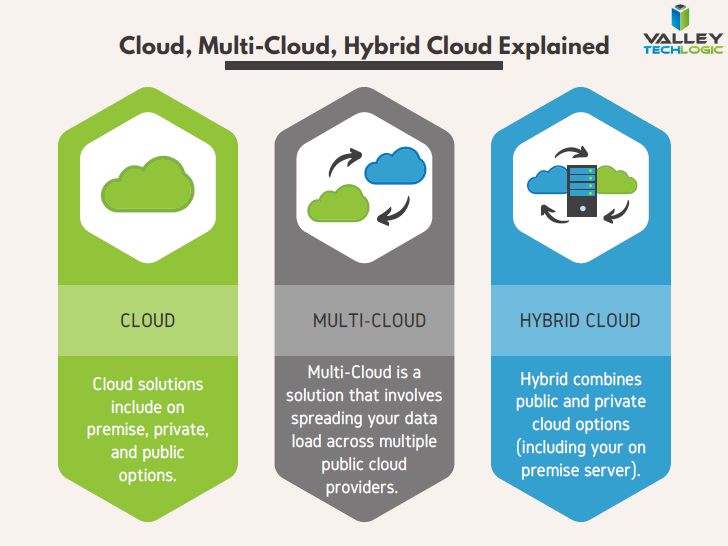
    Still, diversifying our networks would help protect us from outages such as these and major breaches. If you’re a business looking into cloud solutions, you might consider the Multicloud Redundancy approach.  What this means is you might have some of your data and services hosted by AWS and some hosted by another provider.

    Another option is hybrid cloud. Hybrid cloud is when you have a mixture of on premises storage (such as your office server), private cloud services and public cloud services (like AWS).

    Chart of cloud solution options
    Click to view the full size version.

    At Valley Techlogic we utilize AWS, but we also take the hybrid cloud approach. In fact, our backup program TechVault utilizes three different methods of storing your data. In this world of uncertainty when it comes to cybersecurity attacks and online outages that you have no control over, diversity is key.

    If you would like to learn more about TechVault or need help with your cloud service choices, reach out to us today.

    Looking for more to read? We suggest these other articles from our site.

    This article was powered by Valley TechLogic, IT service provider in Atwater, CA. You can find more information at https://www.valleytechlogic.com/ or on Facebook at https://www.facebook.com/valleytechlogic/ . Follow us on Twitter at https://x.com/valleytechlogic.

  • Grab our 2021 HIPAA compliancy checklist and see how you can address HIPAA in the New Year

    Grab our 2021 HIPAA compliancy checklist and see how you can address HIPAA in the New Year

    HIPAA (which was enacted on August 21, 1996) is not a new topic for healthcare providers and those who handle Protected Healthcare Information (PHI), yet many healthcare providers still do not meet the target goals assigned by the program to prevent a data breach that could devastate their business.

    That may be due to the cost and complexity that surrounds meeting all of the necessary components of HIPAA. It’s estimated the actual costs of HIPAA compliancy are around $8.3 billion per year. For physicians, they can be looking to spend $35,000 a year to meet the technology requirements alone.

    When you look at the numbers, it’s easy to see why many healthcare providers would simply choose to roll the dice under the assumption there’s only a small chance their business would ever be affected by a breach or cyberattack. We’re here to tell you, that’s really not a good idea.

    Patient records and other PHI data is some of the most valuable data available on the Dark Web, with patient records averaging $250 to $1000 each. That means even a small doctors office may be sitting on hundreds of thousands of dollars’ worth of data to would be cyber criminals.

    These records are then used to create credible profiles for criminals such as drug traffickers, who use them to purchase prescription medications under your client’s identity (while also having your clients’ personal details, such as where they live). This means a breach would not only be a risk to your business but also equals a risk to your client’s safety.

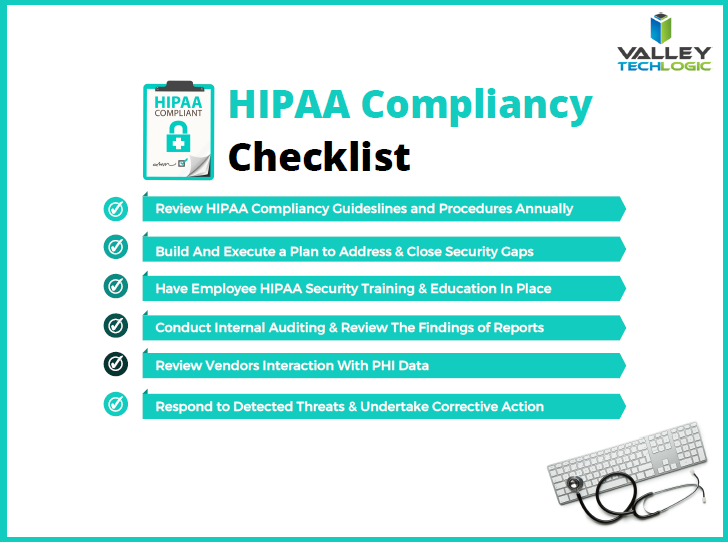
    We know no provider would willingly put their client’s health and safety in jeopardy, it’s antithetical to the oaths that healthcare workers commit to as they launch into their chosen profession. Knowing the risks involved doesn’t make the hurdles associated with implementing HIPAA effectively in your business any less daunting. That’s why we’re here to help, below is the checklist with the six most effective measures you can implement in 2022 to bring your business to HIPAA compliancy.

    HIPAA Compliancy Checklist
    Click to view the full version.

    Many of those items are not difficult to implement even sooner, such as security awareness training (the number one cause of data breaches is human error).

    Reviewing the way your vendors handle PHI data and obtaining confirmation that they’re protecting things on their end is also as simple as making some phone calls.

    For other items, such as an annual HIPAA checkup it may be best to have a technology partner that can help you not only address your current HIPAA concerns but also a path forward that includes accessible goals for your business.

    If you’re in the Central Valley, Valley Techlogic can be that partner. Many of our clients are in the healthcare sector, and we have helped them establish their compliancy with HIPAA and have helped them maintain it going forward.

    We have over a decade of experience with the topic of cybersecurity and can apply our tools and knowledge directly to your business under one of our easy to budget for inclusive monthly plans. Schedule a quick call to learn more about how we can help your business be HIPAA compliant in the new year.

    Looking for more to read? We suggest these other articles from our site.

    This article was powered by Valley TechLogic, IT service provider in Atwater, CA. You can find more information at https://www.valleytechlogic.com/ or on Facebook at https://www.facebook.com/valleytechlogic/ . Follow us on Twitter at https://x.com/valleytechlogic.
  • Hackers and the holidays, US government warns ransomware doesn’t take days off

    Hackers and the holidays, US government warns ransomware doesn’t take days off

    As you prepare to take some time off to enjoy with your families (especially if a certain health crisis kept the festivities to a minimum in 2020) it’s important to take some steps to make sure your business is still protected in your absence.

    The Cybersecurity and Infrastructure Security Agency (CISA) issued an advisory yesterday to businesses and consumers alike, warning that hackers often take advantages of holidays and other times people may let their guard down to wreak more havoc.

    The advisory included a warning of a possible increase on the following cyber threat events:

    1. Phishing attacks: That email from your Aunt Beth seeing if you’re going to bring the green bean casserole with a “Google Form” to check it off may not be what it seems to be.
    2. Fraudulent site spoofing: Especially for sites that may be seeing increased traffic due to holiday shopping (Black Friday anyone?).
    3. Unencrypted financial transactions: An easy way to check, is to look for the S in HTTPS, don’t enter your financial data into unencrypted websites.

    Beyond attacks aimed at individuals, attacks aimed at businesses also tend to rise during the holidays and on weekends.

    Such was the case for the attack on Kaseya, which occurred over Fourth of July weekend in 2021, and the Colonial Pipeline hack happened during Mother’s Day weekend the same year. Hackers realize there is less coverage on the weekend and during Holidays and they have taken advantage of it to great success.

    It’s not just large businesses that are a target either, many wannabe hackers have day jobs too and more time on their hands during the holidays to target businesses that could be local to them. That includes yours.

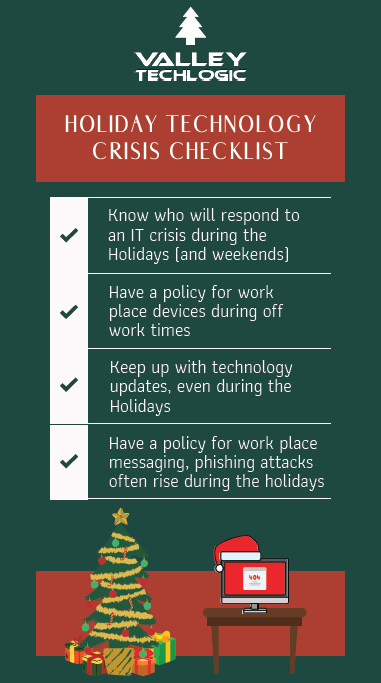
    So, here’s a list of things to check off before you leave the office this week to enjoy some well deserved time off.

    Holiday Crisis Checklist
    Click to view the full size version.

    As you can see, our number one recommendation is knowing who is going to cover your business if a cyber event does happen while everyone is home for the holidays. If you try to think of who that person is and you either come up empty or maybe it’s you, that’s a problem.

    Another problem is if your normal IT coverage is on a one time or break fix solution basis. The service you normally use could either be too swamped themselves to help you during the holidays, or maybe they’re taking time off too and are simply unavailable to help you.

    This is where having a contract with a technology service provider could really save the day during a crisis. When you have a contract with a business to provide your technology services, they’re bound by the service level agreement (SLA) you sign at the start of service. They will be better equipped to help your business if there’s a crisis – even during the holidays.

    If you’re in the Fresno, Modesto, Sacramento or anywhere else in the Central Valley and aren’t really sure who you would turn to if a technology crisis occurred during the holidays, Valley Techlogic is here for you. Learn more today.

    Looking for more to read? We suggest these other articles from our site.

    This article was powered by Valley TechLogic, IT service provider in Atwater, CA. You can find more information at https://www.valleytechlogic.com/ or on Facebook at https://www.facebook.com/valleytechlogic/ . Follow us on Twitter at https://x.com/valleytechlogic.

  • Cybersecurity Maturity Model Certification 2.0 has been announced, what it means for you and your business

    Cybersecurity Maturity Model Certification 2.0 has been announced, what it means for you and your business

    If you’re a contractor or subcontractor for the Department of Defense (DoD) you probably at least have an awareness of the evolving situation surrounding the CMMC (Cybersecurity Maturity Model Certification) program, or maybe you’ve even begun the self-assessment process.

    Announced summer of 2019, version 1.0 was released January 31st, 2020, and a 5 year roll out was planned to get DoD contractors and subcontractors compliant with the framework. The framework is based on the security controls found in the National Institute of Standards and Technology (“NIST”) Special Publication (“SP”) 800-171, with many of the security controls found in CMMC having a direct correlation to a control found in NIST 800-171.

    While the initial CMMC framework was aimed at bringing defense contractors up to speed in their cybersecurity efforts to protect critical Controlled Unclassified Information (CUI), the use of the broad term CUI instead of the defense specific Covered Defense Information (CDI) phrase may indicate that this framework will extend beyond just defense contractors in the future.

    The controls found in NIST are applicable to businesses of all sizes and in all sectors so following the CMMC or NIST frameworks whether or not you’re defense contractor/subcontractor will mean your business will be well protected and compliant with rules and regulations set by your vendors, clients, and services for your business such as cybersecurity insurance.

    In it’s original iteration there were 5 maturity levels found in CMMC, with levels 1-3 really closely following NIST and 4-5 going beyond the scope of what NIST covers. They were described as “maturity levels” as they were meant to measure the maturity of the cybersecurity practices found within your organization.

    For most defense contractors, reaching level 3 of CMMC would be an ideal goal. Levels 4 and 5 covered practices outside the scope of most business’s and would require more specialized (and expensive) security practices. Even in version one of CMMC contractors were allowed to self-certify for maturity level 1, but beyond that would require outside certification. The waiting list to receive that certification is long, so planning to implement the required cybersecurity measures and getting on the waiting list to be certified ASAP is a good idea.

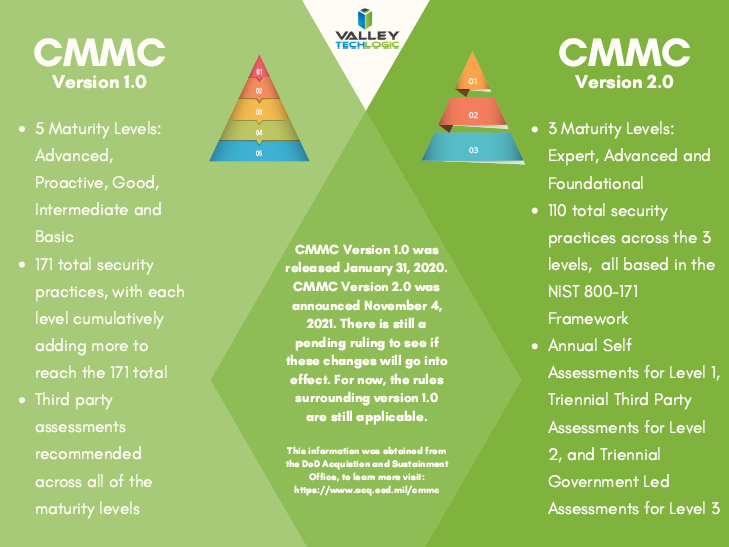
    Now, as of November 4th the DoD has announced an update to CMMC. Version 2 may be removing two of the levels and some of the security measures that were unique to CMMC framework, making the framework match NIST even more closely. Below is the chart we have created with the outlined changes as we know them and as of this posting.

    CMMC Version 1 and 2 Chart
    Click to view the full size.

    This is an evolving situation and as the rollout progresses it’s imperative that businesses that receive DoD contracts begin or continue to increase their efforts in becoming CMMC certified, which may mean drastically increasing your cybersecurity efforts across the board.

    Valley Techlogic has experience in helping businesses meet the goals found within the CMMC framework and we’re ready to help your business meet your certification and cybersecurity goals today. Click here to schedule a quick consultation to find out more.

    Looking for more to read? We suggest these other articles from our site.

    This article was powered by Valley TechLogic, adns, n IT service provider in Atwater, CA. You can find more information at https://www.valleytechlogic.com/ or on Facebook at https://www.facebook.com/valleytechlogic/ . Follow us on Twitter at https://x.com/valleytechlogic.
  • Microsoft 365 pricing changes are coming in 2022, and we have the details

    Microsoft 365 pricing changes are coming in 2022, and we have the details

    Microsoft has had a busy year in 2021. With the release of Windows 11 and it’s continued roll out to more and more eligible users, as well as the quieter release of Windows Server 2022 in August. It looks like they’re not slowing down in 2022.

    We’ve been notified as a Microsoft partner there will be price increases across the board for their powerful suite of office software, Microsoft 365 expected in March 2022.

    While it’s never fun to have an unexpected increase to your overall IT spend, we think Microsoft 365 is still well worth it even at the increased cost. There are also some items that will be rolled into the new subscription model that will absorb some of the price increase while increasing the usability of your Microsoft 365 subscription.

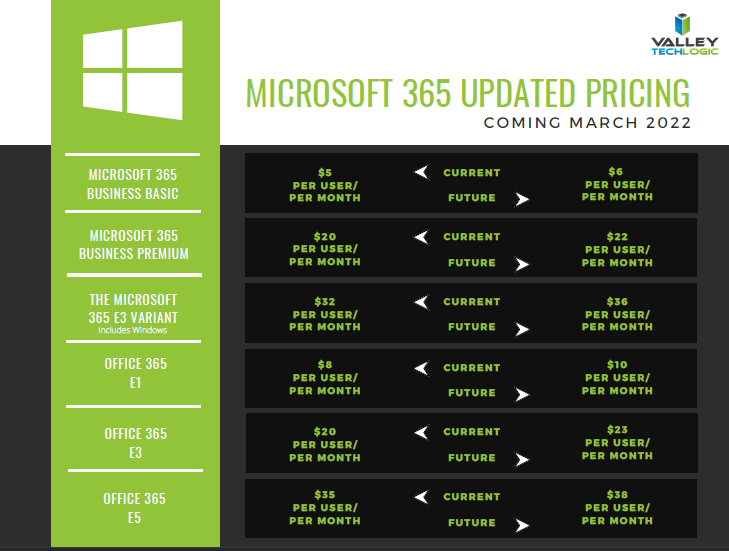
    First, here’s a chart we’ve created that you can save for your records that outlines the expected price increases. These prices may change between now and March but as of writing these are the prices that have been communicated to us by Microsoft directly. We also included the subscription models that are not going to be increased in March. We also want to note the consumer and educational models of Microsoft 365 will not be experiencing a price increase next year.

    Small Version of the Pricing Chart
    Click for the full size version.

    Now, we promised we’d talk about some of the items that are now going to be rolled into your Microsoft 365 subscription that previously had their own cost. One of those items is the ability to call in via Teams. Previously, calling in via Teams was $4 per line but as Microsoft moves to make Teams more accessible for businesses and users alike, they’re now including it in your normal subscription cost.

    This means if you have employees who are out and about during a company meeting, they can still easily call in and participate. It also opens up the opportunity to use Teams for your prospects and clients, even if they don’t currently have it installed. This year we even switched to Teams across the board ourselves and haven’t looked back. We’ve found the call quality and reliability to be phenomenal.

    Some security features will also be rolled into some of the earlier tiers of Microsoft 365 when they were previously featured à la carte. The security and compliance features found in your Microsoft 365 subscription really amount to pennies on the dollar when you consider how expensive it would be to establish the same security stack outside of Microsoft, and it would be less tailored for your own Microsoft use experience to boot.

    These security features include data loss prevention (DLP) for email and documents, as well as encryption for email (we all know email is one of the most common points of entry for bad actors). Microsoft Endpoint Manager has been a critical tool for all of the business’s that now find themselves managing a remote workforce.

    Overall, while a price increase was inevitable, we’re excited to see what new features will be rolled out in 2022 and beyond. If your office is not yet setup with a Microsoft 365 subscription, that’s one of the items we help our clients manage. If you’d like to learn how Valley Techlogic can help your business with Microsoft products and more, click here.

    Looking for more to read? We suggest these other articles from our site.

    This article was powered by Valley TechLogic, adns, n IT service provider in Atwater, CA. You can find more information at https://www.valleytechlogic.com/ or on Facebook at https://www.facebook.com/valleytechlogic/ . Follow us on Twitter at https://x.com/valleytechlogic.
  • How much are you worth on the Dark Web?

    How much are you worth on the Dark Web?

    Not you specifically, but the data that makes up your online activities and private details? What about your various web accounts, for example did you know a hacked Netflix account with 12 months of service is worth $44 on the Dark Web as of 2021?

    We know the Dark Web is a nebulous concept and most of the people we talk to really don’t feel as though it has much to do with them. There’s even those that have resigned themselves to the fact their data is just “out there”, but take solace that in the flux of so many people who experience identify theft (1, 387, 615 reported cases in 2020) there’s just no way a hacker would ever reach them personally.

    If you’re a business owner this is of course, a crock of baloney. While there are many business owners in the US, their numbers pale in comparison to the vast swafts of people who don’t own a business and thereby don’t have valuable employee and financial data within their purview. The fact is by simply owning a business, you’re more vulnerable to being a target of identity theft.

    Business identity theft and consumer identity theft typically occur with the same goal in mind, financial gain for the bad actor. However, business identity theft carries a much larger trickle-down effect. It’s not only your own data that’s at risk, there’s also that of your employees and your business itself.

    Business size doesn’t affect the rate at which you’ll be targeted either, in fact during the COVID pandemic, business identity theft soared across the board.

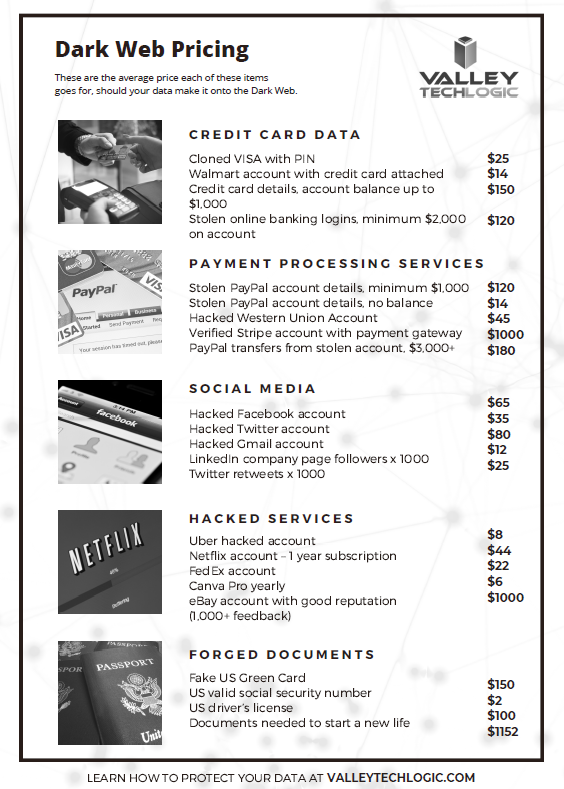
    This all leads us back to what hackers hope to gain and what your financial data and other pertinent details and accounts are really worth on the dark web, we’ve created this chart with some notable items, but you can find the whole list for 2021 here:

    Click to grab the full size version.

    As the website above states, the quantity of these items found on the dark web also has grown considerably in the last year. It’s predicted cyber theft will cost the world $10.5 trillion annually by 2025. Cyber crime is more profitable than the global drug trade at this point in time.

    So instead of thinking “it won’t happen to me” you should begin considering what you will do when it does happen to you, or even better – what you can do to stop it.

    For instance, at Valley Techlogic we provide all of our customers with Dark Web Monitoring as a routine part of their services with us.

    Dark web monitoring won’t stop your details from being leaked but it will help you monitor and prevent further damage. If your credentials are made available to hackers and you’re aware of it, it’s a lot easier to change them ahead of any damage being done to your accounts and systems.

    You can also partner with an IT provider who has a cyber security stack that exceeds what you could procure on your own. This allows you to take advantage of a robust cyber security package without trying to manage and absorb the cost yourself, allowing you to protect your business and even save money.

    Finally, your provider can help you comply with a cybersecurity framework recommended by the US government, such as NIST or CMMC. This will offer you the best most comprehensive protection from business identity theft.

    Valley Techlogic can assist you with all of these recommended cybersecurity practices. Learn more by taking a quick 10 minute discovery call with one of our tech experts.

    Looking for more to read? We suggest these other articles from our site.

    This article was powered by Valley TechLogic, an IT service provider in Atwater, CA. You can find more information at https://www.valleytechlogic.com/ or on Facebook at https://www.facebook.com/valleytechlogic/ . Follow us on Twitter at https://x.com/valleytechlogic.
  • 10 scary cybersecurity statistics business owners need to know

    10 scary cybersecurity statistics business owners need to know

    Halloween is approaching and we thought it would be appropriate to cover some bone chilling cybersecurity statistics business owners NEED to know to protect their business.

    Cybersecurity is something we all know we need to do more about but also don’t like to think about, however for business owners’ avoidance won’t make the threats any less real.

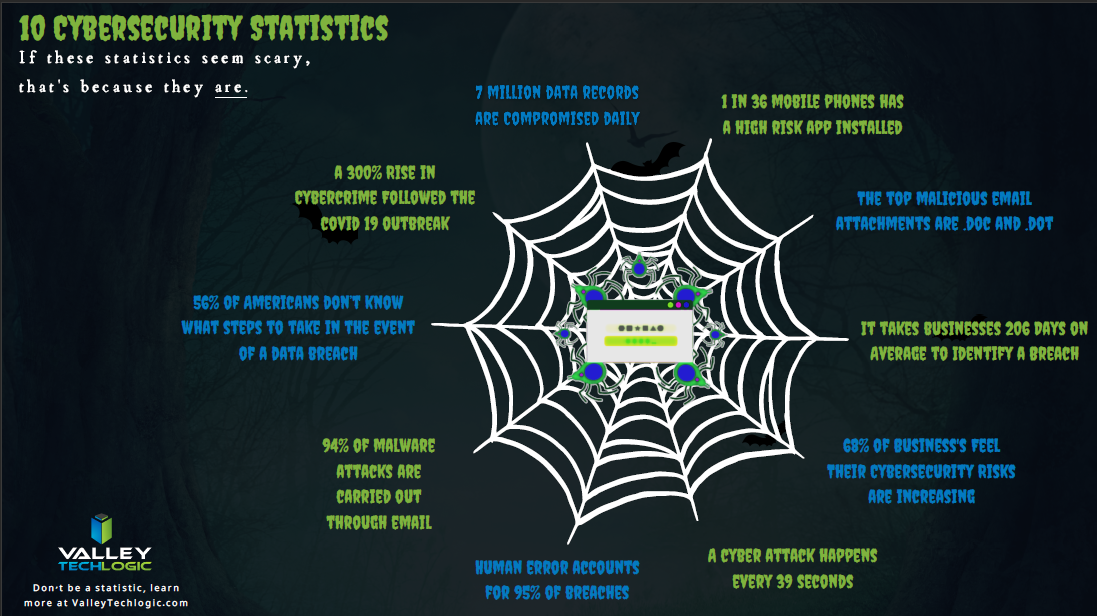
    Take a look at our web of cybersecurity statistics and read on to learn how they can make a mess for your business (and what you can do to fix it).

    Click to view the full size version.

    While these statistics are scary, we already suspect you’re thinking “it won’t happen to me”. The reasons business owners come to this conclusion are numerous but the top 3 we’ve encountered are.

    1. My business is too small.
    2. I’m not in a sector that’s targeted by hackers.
    3. Even if I was hacked, I don’t have anything they would want.

    That last one is a real headscratcher for us. What business operates without any financial data? What about your personal data and that of your employees? Your customers? That’s all valuable data on the dark web.

    The scariest statistic of all that wasn’t included in our chart is that 60% of businesses fail following a cybersecurity event.

    Preventing an attack is crucial for your business, remediating an attack after the fact is not a clear-cut solution. Usually not all of your data can be recovered, you can’t make up for the lost time spent dealing with the attack, and if it becomes public your reputation may never be what it once was.

    There are easy solutions you can put in place today that will reduce your risk dramatically.

    1. Educate your employees about phishing emails, this is one of the biggest sources of threat events.
    2. Ensure two-factor or multi-factor authentication is required on company systems and devices.
    3. Have a company wide password policy that includes not sharing your password with others and coming up with complex yet memorable passwords that can’t be brute forced by a would be attack.

    If it’s all overwhelming and you don’t know where to start, we don’t blame you. Navigating the complicated world of cybersecurity is really something that business owners should let a professional handle. If you’re in the Central Valley, Valley Techlogic can be your partner in security and more. Learn more today.

    Looking for more to read? We suggest these other articles from our site.

    This article was powered by Valley TechLogic, adns, n IT service provider in Atwater, CA. You can find more information at https://www.valleytechlogic.com/ or on Facebook at https://www.facebook.com/valleytechlogic/ . Follow us on Twitter at https://x.com/valleytechlogic.

  • 5 Ways “Tribal Knowledge” Sabotages Your Cybersecurity Efforts

    5 Ways “Tribal Knowledge” Sabotages Your Cybersecurity Efforts

    Even if you’re unfamiliar with the phrase “tribal knowledge” you’ve still most likely participated in it. Tribal knowledge is anything in your workplace people just “know”. If you have a particular co-worker that gets upset if the AC is turned down below 75 so no one does, that’s tribal knowledge. If the snacks in the breakroom are first come first serve and no one can claim dibs, that’s also tribal knowledge.

    Tribal knowledge is anything in your workplace that is common knowledge and is not documented. If the rules are posted somewhere it goes from being tribal knowledge to policy, and when it comes to the technology in your business, it is much more secure to rely on policy than tribal knowledge.

    Having policies for your technology holds everyone in your organization accountable. No one can claim they didn’t know the rules if the rules are clearly outlined and defined. Having effective policies are also necessary for maintaining your compliancy with federal rules regarding cybersecurity and business and for meeting the requirements for things like cybersecurity insurance.

    Here are the five ways tribal knowledge typically sabotages your cybersecurity efforts:

    1. The rules are loosely applied. If somethings not policy, then it can be difficult to make sure everyone is on the same page. A new hire will not be aware of your rules from the start and others may feel the rule doesn’t apply to them because they haven’t been strictly told it does.
    2. The rules are up to interpretation. What you think something means and what someone else may interpret something meaning can be vastly different, especially when being communicated person to person where some of it is probably getting lost in translation.
    3. You have no documentation. If the guidelines for online safety in your business are communicated verbally, you have no documentation for how or when they’re being applied. If you have a ransomware attack and you go to your insurance company without documentation, you’ll most likely be turned down.
    4. You’re not keeping up with the times. If you have employees stuck on the way things “have always been done” instead of evolving policies to fit your workspace as it grows, you’re going run into a problem if you ever need to implement comprehensive cybersecurity changes in the future.
    5. You’re losing access to relevant data. Policies help you document your processes, and that documentation is data that could help your business grow. If a certain activity is not working or could be working better, the documentation you’re creating with comprehensive policies could help you find out sooner which will save your business time and money.

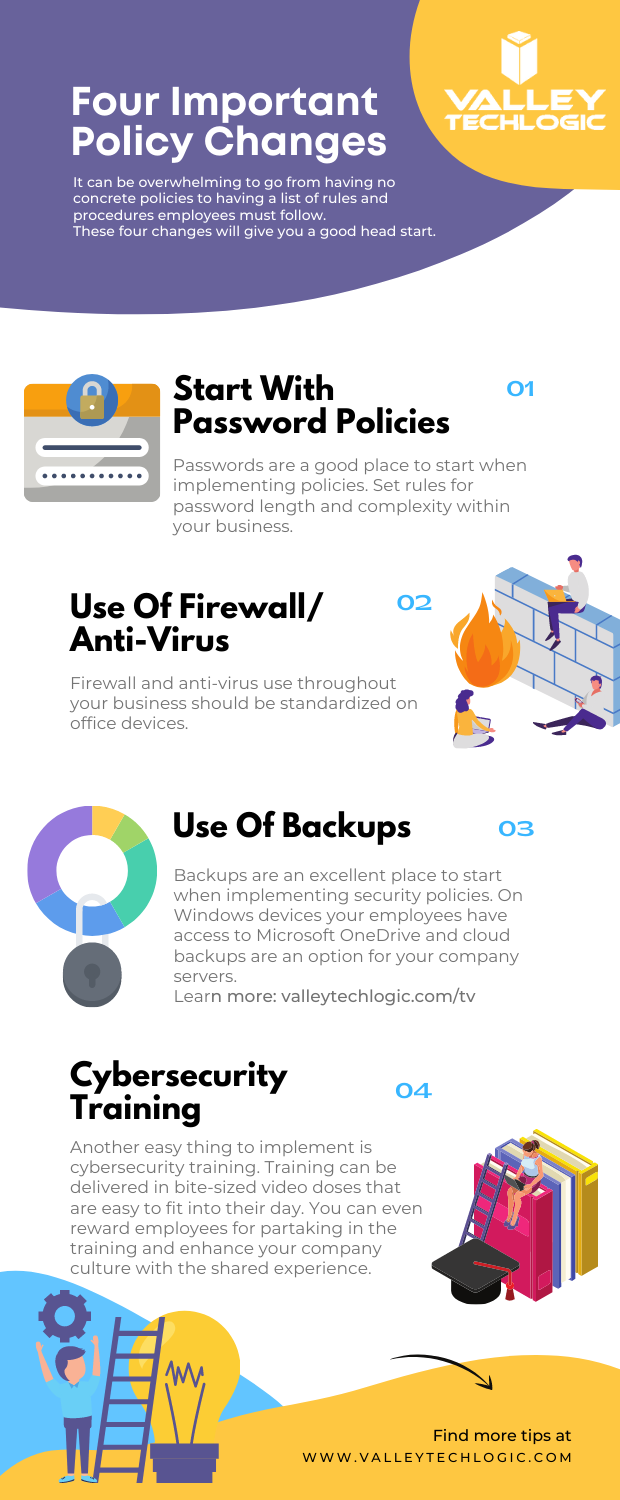
    In addition to these five tips, we’ve also created this PDF for four easy things to implement in your business (click to download).

    Four Policy Changes To Start With
    Click to download.

    These items will get you on the right track but if you feel like it’s time to get serious about cybersecurity, it’s best to leave it to the professionals. At Valley Techlogic, we have over 15 years in the cybersecurity space. We have a robust cybersecurity package that can be used standalone to leverage our cybersecurity stack if you already have an IT team in place or in conjunction with our IT service plans if you don’t currently have reliable assistance for your business’s technology. Schedule a consult today to learn more.

    Looking for more to read? We suggest these other articles from our site.

    This article was powered by Valley TechLogic, adns, n IT service provider in Atwater, CA. You can find more information at https://www.valleytechlogic.com/ or on Facebook at https://www.facebook.com/valleytechlogic/ . Follow us on Twitter at https://x.com/valleytechlogic.
  • October is National CyberSecurity Awareness Month, Our Checklist Will Get You Started

    October is National CyberSecurity Awareness Month, Our Checklist Will Get You Started

    Every October the CyberSecurity & Infrastructure Security Agency (CISA) releases a list of resources and tips for National CyberSecurity Awareness Month – which is now in its 18th year.

    This year’s theme is “Do Your Part. #BeCyberSmart”. There has been an onslaught of news worthy ransomware attacks, DDoS attacks and data breaches (up 38% this year compared to last) in 2021 and there has never been a better time to address what the average person or business can do so they don’t end up as part of these statistics.

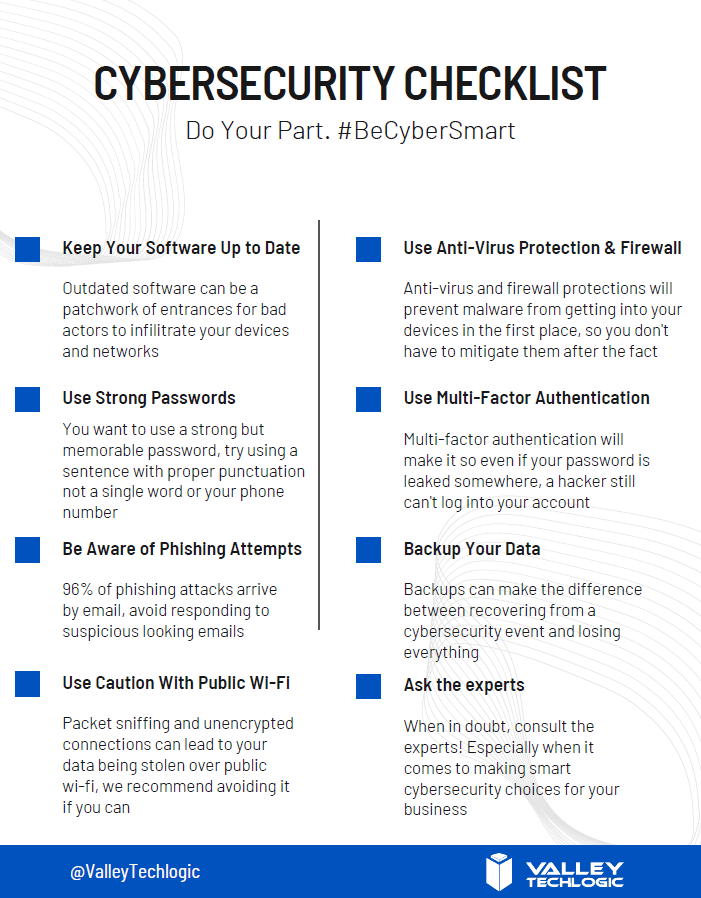
    We’ve created this checklist so you can see if you’re following the right path to keep your business safe from outside intruders.

    Click to download the online capable version.

    Cybersecurity requires ongoing maintenance to succeed. Following simple safety steps will help but it’s important not to disregard active threats to your business from the outside.

    Ongoing employee training is one way to combat those threats, cybersecurity training has evolved to include bite size doses of good advice for your employees that could make the difference between inadvertently falling for a phishing scam or attack attempt and reporting it to your IT team as they should. 95% of data breaches involve human error.

    It can also be important to have a team behind you making sure all of your company devices are maintained and updated, even if that outdated Windows 7 computer that sits in a corner is barely used it can still be a threat to your business. Older devices with outdated software can act as a gateway to allow bad actors into your business.

    More advanced maintenance such as enabling two-factor or multi-factor authentication on company accounts can be another important step to keeping threats out. If someone gets your password from another company’s data breach (which happens all the time) that phone pop up could prevent you from being hacked.

    Finally, having a comprehensive backup program for your businesses data is the final shield against cyber threats. We’re unique in that we offer not only active backups but archival backups as well. The archival backup is “Write once, Read many” which means you can look at the data as often as you like but it can’t be edited or deleted.

    A bad actor may find your unbacked up data, and they may gain access to your active backups, but that archival data is virtually bullet proof. For your important files, the ones that must not be deleted at any cost, having that backup there and ready if you need it is the peace of mind most of us would not want to be without (learn more about our backup program here).

    If this article has gotten you thinking about what you can do to improve your cybersecurity processes or even that you need to create a plan to get there, we’d love to help. Schedule a discovery call with us to learn more about how Valley Techlogic can help you be #CyberSmart.

    Looking for more to read? We suggest these other articles from our site.

    This article was powered by Valley TechLogic, adns, n IT service provider in Atwater, CA. You can find more information at https://www.valleytechlogic.com/ or on Facebook at https://www.facebook.com/valleytechlogic/ . Follow us on Twitter at https://x.com/valleytechlogic.